
Most LegalShield leads aren’t lost because the plan was a hard sell — they’re lost because nobody followed up enough times, or followed up the wrong way. If you’re generating leads through salesexpert.me, social prospecting, or referrals but your close rate feels stuck, the fix is rarely “get more leads.” It’s almost always the follow-up system sitting underneath them.
This guide breaks down a follow-up cadence built specifically for legal plan sales, the messaging that keeps prospects warm without feeling pushy, and the tools that make consistency possible even when you’re juggling a full pipeline.
Why Follow-Up Is Where Most Associates Lose the Sale
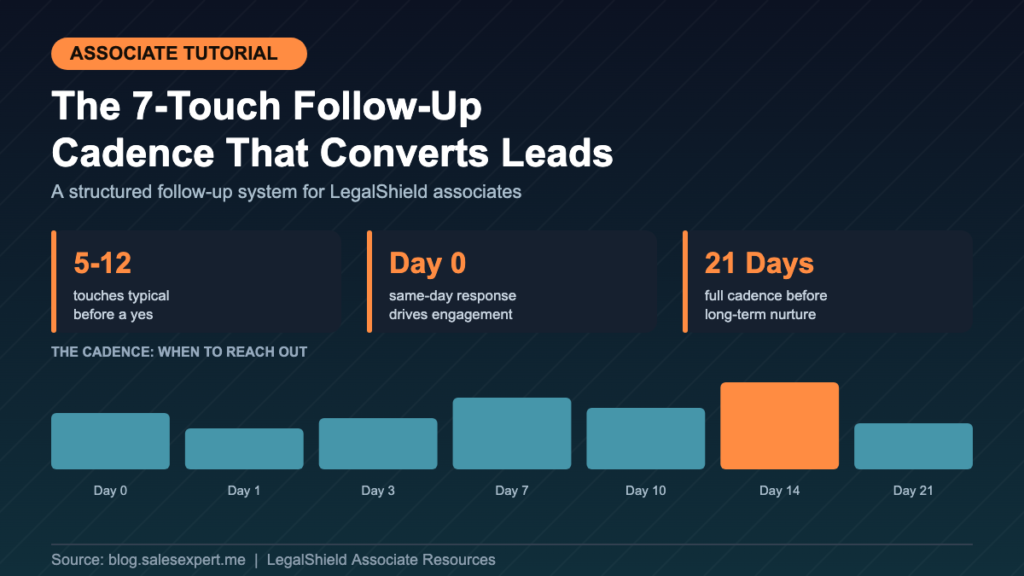
Sales research across industries consistently shows that most buyers say yes somewhere between the fifth and twelfth touchpoint — yet most salespeople stop reaching out after one or two attempts. Legal plans are no exception. A prospect who requested information about a LegalShield plan is rarely ready to buy on contact one. They’re comparing cost against perceived risk, they may not fully understand what’s covered, and life gets in the way of replying.
That gap between “interested enough to ask” and “ready to enroll” is exactly where a structured follow-up cadence earns its keep. Associates who treat follow-up as a system, rather than a reminder to “check back in,” consistently see higher conversion from the same lead volume.
The 7-Touch Follow-Up Cadence
Instead of guessing when to reach back out, work from a set cadence. This one is built around the reality that legal-plan decisions usually take one to three weeks:
- Day 0 — Same-day response. Speed matters more than almost anything else. A lead contacted within the first hour is dramatically more likely to engage than one contacted the next day.
- Day 1 — Value follow-up. Don’t just “check in.” Send one specific piece of value: a short answer to a common question, or a one-line example of what the plan covers relevant to their situation.
- Day 3 — Social proof. Share a brief, real story (with permission) of how a plan member used their coverage. Concrete scenarios convert better than feature lists.
- Day 7 — Address the objection. By now you likely know what’s holding them back — cost, timing, uncertainty. Speak to it directly rather than repeating your pitch.
- Day 10 — Urgency without pressure. Reference a real reason to decide now — an upcoming life event they mentioned, a plan detail, or simply that unresolved legal exposure doesn’t pause while they wait.
- Day 14 — The direct ask. A short, respectful message that plainly asks whether they’d like to move forward or if you should close the file.
- Day 21 — Long-term nurture. If there’s still no response, move them into a monthly nurture sequence rather than deleting the lead. Circumstances change, and many enrollments happen well past the initial window.
Match the Channel to the Moment
Cadence matters, but so does channel. Early touches (Day 0-3) tend to perform best by phone or text, where the response is immediate. Mid-cadence touches (Day 7-14) work well over email, since they carry more detail. Later nurture touches are well suited to text or a quick social message — low-friction, easy to answer.
Messaging That Keeps Leads Warm
The words you use in follow-up matter as much as the timing. A few principles that consistently improve response rates:
Lead with a question, not a pitch
“Did you have a chance to look at the family plan details?” invites a reply. “Just checking in!” invites silence. Every follow-up message should end with something easy to answer.
Reference something specific
Generic follow-ups get ignored because they read like automation. Referencing the exact plan, concern, or life situation the prospect mentioned signals that a real person is paying attention.
Keep it short
Follow-up messages are not the place to re-explain the entire plan. One idea, one question, one clear next step.
Tools to Make Consistency Easier
Discipline fades under a busy pipeline — systems don’t. A few practical tools help associates stay on cadence without relying on memory:
- A simple CRM or spreadsheet tracker that flags which day of the cadence each lead is on.
- Saved message templates for each touchpoint, customized in under a minute per lead rather than written from scratch.
- Calendar reminders or task blocks dedicated specifically to follow-up, separate from new-lead outreach, so warm leads never get crowded out by new ones.
- salesexpert.me lead tools, which help associates track where each prospect came from and prioritize follow-up based on engagement signals.
What to Track
To know whether your follow-up system is actually working, track three numbers over a month: response rate by touchpoint (which message is actually getting replies), average number of touches before enrollment, and conversion rate for leads that receive the full cadence versus those that get one or two attempts. Most associates who start measuring this are surprised by how many enrollments come from touch five, six, or later — the ones they used to skip.
The Bottom Line
Better leads help, but a stronger follow-up system is usually the faster path to more enrollments. Build the cadence, keep the messaging specific and short, and use tools that keep you consistent when the pipeline gets busy. The associates who out-earn their peers aren’t always the ones with the most leads — they’re the ones who follow up when everyone else has already given up.
Ready to put this into practice? Log in to salesexpert.me to review your current lead pipeline, flag which prospects are overdue for a follow-up touch, and put this cadence to work on your next batch of leads.